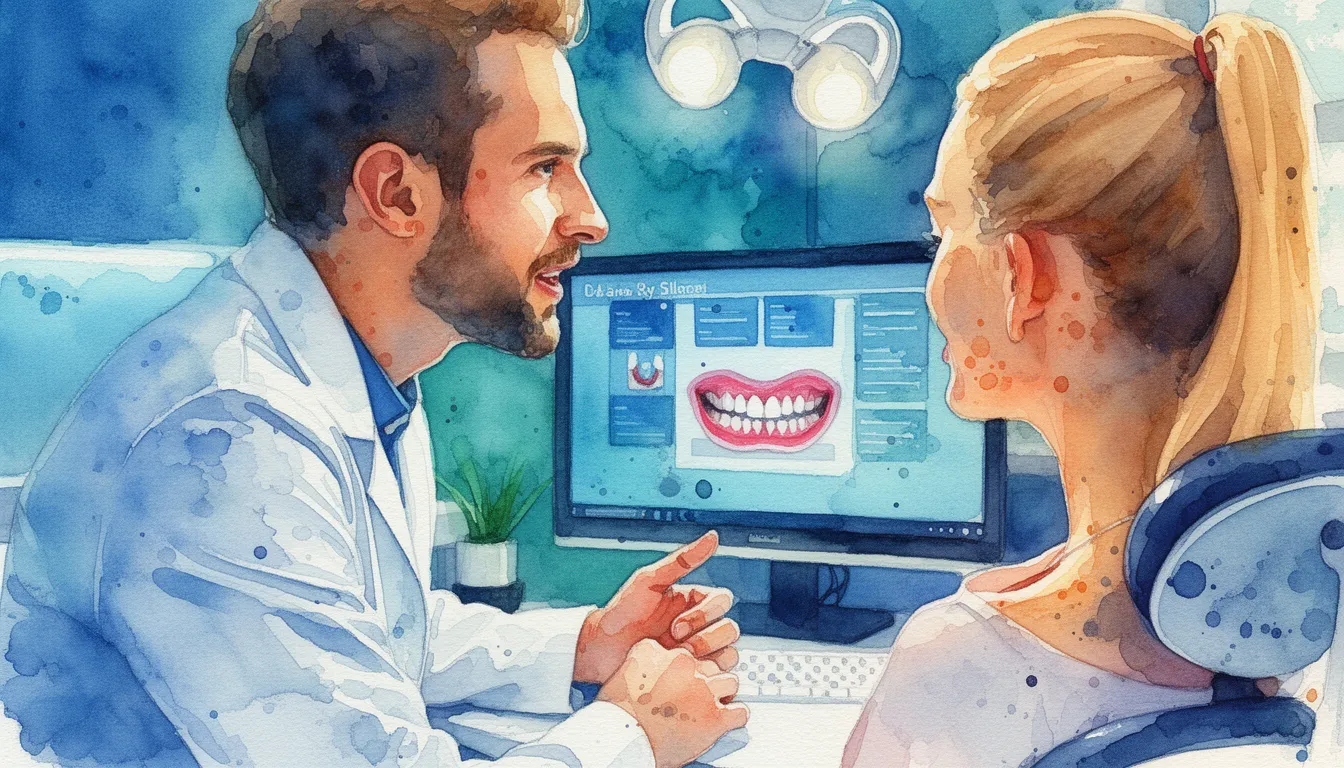
What This Guide Covers
This guide explains what an open bite is, what causes it, and how orthodontists correct it in both children and adults. You will find details on every major treatment option, from simple habit appliances to orthognathic (jaw) surgery.
An open bite is a type of malocclusion, which is the clinical term for teeth that do not line up properly. When you bite down, the front teeth or back teeth fail to make contact. This leaves a gap that can affect chewing, speech, and appearance. [1]
The information here applies to anyone who has been told they have an open bite, suspects they may have one, or is researching treatment for a child. Whether you are exploring early intervention for a young child or considering adult correction, each section is organized so you can find the details most relevant to your situation.
Understanding Open Bite: Types, Causes, and Severity
An open bite occurs when a group of upper and lower teeth cannot make contact while the jaw is fully closed, creating a visible space between them. [1]
Types of Open Bite
There are two main types. An anterior open bite affects the front teeth. When you bite down on your back teeth, the front teeth do not touch and a gap remains. A posterior open bite is the opposite: the front teeth meet, but some or all of the back teeth do not. Anterior open bite is significantly more common. [1]
Some patients have a combination of both. The type and location of the gap helps the orthodontist determine the cause and plan the right treatment. Your orthodontist will measure the size of the gap in millimeters. A gap of 1 to 2 millimeters is considered mild, while gaps greater than 5 millimeters are typically classified as severe.
What Causes an Open Bite
Open bites develop from habits, skeletal growth patterns, or a combination of both. Understanding the root cause is critical because it shapes which treatment will work best and how stable the results will be long term.
Habitual causes are the most common in children. Prolonged thumb sucking, pacifier use past age 3, and tongue thrusting (a pattern where the tongue pushes forward against or between the teeth during swallowing) can push the front teeth apart over time. [1] If these habits stop early enough, the open bite may partially or fully self-correct as the child grows.
Skeletal causes involve the way the jawbones grow. Some people inherit a growth pattern where the lower jaw rotates downward and backward, increasing the vertical distance between the upper and lower teeth. This is sometimes called a "long face" growth pattern. Skeletal open bites tend to be more severe and less likely to respond to braces alone.
Other contributing factors include temporomandibular joint (TMJ) disorders, which can change how the jaw closes, and certain conditions like rheumatoid arthritis that affect the joint over time. [1] In some cases, the cause is a combination of habit and skeletal factors, which requires a multi-phase treatment plan.
How an Open Bite Affects Daily Life
The gap created by an open bite is more than a cosmetic concern. When front teeth cannot meet, biting into food like sandwiches, apples, or corn on the cob becomes difficult. Many patients unconsciously shift chewing to the back teeth or to one side, which can lead to uneven tooth wear over years.
Speech can also be affected. Sounds like "s," "z," and "th" require the tongue to interact with the front teeth. An open bite may cause a lisp or other speech pattern changes. Some patients also experience mouth breathing and dry mouth because the lips cannot fully close at rest. [1]
Treatment Options by Age and Severity
Treatment for an open bite depends on the patient's age, the cause of the bite problem, and how severe the gap is.
Children: Early Intervention (Ages 7 to 10)
The American Association of Orthodontists recommends that every child have an orthodontic evaluation by age 7. [2] At this age, an orthodontist can spot developing open bites while the jaw is still growing. Early treatment can sometimes prevent more complex correction later.
For habit-related open bites, the first step is stopping the habit. If a child cannot stop thumb sucking on their own, a habit appliance may help. This is a small metal device bonded behind the upper front teeth. It acts as a physical reminder that makes it uncomfortable to place the thumb or tongue against the teeth. In many cases, once the habit stops, the teeth begin to move toward a more normal position on their own.
If there is a skeletal component, a palatal expander or other growth-modification appliance may be used. These devices take advantage of the child's active growth to guide the jaw into better alignment. Treatment at this stage typically lasts 6 to 12 months, though follow-up monitoring continues as permanent teeth come in.
Teens and Adults: Braces and Clear Aligners
Once a patient has all or most of their permanent teeth, traditional braces or clear aligners become the primary treatment tools. Both work by applying controlled forces to move teeth into proper alignment. For mild to moderate anterior open bites, either option can be effective.
Traditional metal or ceramic braces give the orthodontist precise control over tooth movement in all three dimensions. Elastics (rubber bands) are often a key part of treatment. They connect the upper and lower arches and pull the front teeth together to close the gap. Patient cooperation with elastics is one of the biggest factors in treatment success.
Clear aligners can treat many open bite cases, though they have historically been considered better suited for milder cases. Advances in aligner technology have expanded the range of treatable cases. Your orthodontist may recommend attachments, which are small tooth-colored bumps bonded to certain teeth, to give the aligners better grip for the specific movements needed.
Temporary anchorage devices (TADs) are another tool sometimes used alongside braces or aligners. TADs are tiny titanium screws placed into the jawbone under local anesthesia. They serve as fixed anchor points, allowing the orthodontist to push or pull teeth in directions that would otherwise be difficult. TADs are removed once treatment is complete.
Severe or Skeletal Cases: Jaw Surgery
When the open bite is caused primarily by the shape or position of the jawbones rather than the teeth, braces alone may not be enough. Orthognathic surgery, commonly called jaw surgery, repositions the upper jaw, the lower jaw, or both to correct the skeletal imbalance.
This treatment typically involves a combined approach. The patient first wears braces for 12 to 18 months to align the teeth within each arch. Then an oral and maxillofacial surgeon performs the jaw surgery. After surgery, the patient continues wearing braces for several more months to fine-tune the bite. Total treatment time for surgical cases is often 2 to 3 years, including the healing period.
Jaw surgery is performed under general anesthesia in a hospital setting. Recovery typically involves a modified soft diet for 4 to 6 weeks and gradual return to normal activity. While this is the most involved treatment option, it produces the most predictable results for severe skeletal open bites and typically offers the best long-term stability for these cases.
Retention and Long-Term Stability
Open bites are considered one of the most relapse-prone orthodontic problems. Relapse means the teeth shift back toward their original position after treatment. This makes the retention phase, which is the period after active treatment ends, especially important.
Most orthodontists prescribe a combination of fixed retainers (thin wires bonded behind the front teeth) and removable retainers. Patients are typically asked to wear removable retainers full-time for several months and then transition to nighttime wear. In many cases, nighttime retainer use is recommended indefinitely.
Addressing the underlying cause is equally critical for stability. If a tongue thrust habit persists after braces, it can push the teeth apart again. Myofunctional therapy, a set of exercises that retrain the tongue and facial muscles, is sometimes recommended alongside or after orthodontic treatment to reduce relapse risk.
What to Expect During Treatment
Open bite treatment follows a structured process that begins with diagnosis and ends with long-term retention.
Initial Evaluation and Diagnosis
Your first visit to an orthodontist for an open bite will typically include a clinical exam, digital X-rays, photographs of your face and teeth, and either physical impressions or a 3D digital scan of your teeth. The orthodontist uses a cephalometric X-ray (a side-view X-ray of the skull) to measure the angles of your jaw and determine whether the open bite is dental, skeletal, or both. [2]
Based on these records, the orthodontist will present a diagnosis and one or more treatment plans. This is the time to ask questions about expected treatment length, the pros and cons of different appliance options, and what your role will be during treatment.
Active Treatment Phase
Once you begin treatment, you will visit the orthodontist's office every 4 to 8 weeks for adjustments or to receive new aligner trays. Each visit is typically brief, lasting 15 to 30 minutes.
With braces, expect some soreness for a few days after each adjustment as the teeth respond to new forces. With clear aligners, mild pressure is normal when you switch to a new tray. Throughout treatment, the orthodontist will monitor progress with periodic X-rays or scans and make adjustments to the plan as needed.
For non-surgical cases, active treatment typically lasts 12 to 30 months. More complex cases with significant vertical discrepancies or skeletal components tend to take longer. Surgical cases add an additional recovery phase of roughly 4 to 8 weeks before orthodontic fine-tuning resumes.
After Treatment: The Retention Phase
When your orthodontist removes your braces or tells you to stop wearing aligners, treatment is not truly over. The retention phase begins immediately. You will receive retainers and specific instructions on how long to wear them each day.
Follow-up visits are typically scheduled at 1 month, 3 months, 6 months, and 12 months after treatment ends. These visits allow the orthodontist to check that the bite remains stable and the retainers fit properly. Consistent retainer wear is the single most important thing you can do to protect your results.
Cost of Open Bite Correction
Open bite correction costs depend on the treatment type, the length of treatment, your geographic location, and your provider's experience. Costs vary by location, provider, and case complexity.
As a general guide, braces for open bite correction typically fall in the range of $3,000 to $7,000. Clear aligner treatment for open bite cases may fall in a similar range, though complex cases requiring attachments and elastics can be on the higher end. These ranges are general estimates and can be higher or lower depending on your area and your specific treatment plan.
Surgical correction is significantly more expensive. The combined cost of braces plus orthognathic surgery typically ranges from $20,000 to $40,000 before insurance. The surgical portion is sometimes covered by medical insurance rather than dental insurance, especially when the open bite causes functional problems like difficulty chewing or breathing.
Many orthodontic offices offer payment plans that break the total fee into monthly installments. Ask about financing options during your consultation. Also confirm whether the quoted fee includes retainers and follow-up visits, as these are sometimes billed separately.
When to See an Orthodontist
An orthodontist is the right specialist to evaluate and treat an open bite. General dentists can identify the condition, but correction requires specialized training in tooth movement and jaw alignment.
You or your child should see an orthodontist if you notice a visible gap between the upper and lower front teeth when biting down, difficulty biting into food with the front teeth, a lisp or speech difficulty that may be related to tooth position, or a child who still thumb sucks or tongue thrusts past age 4. [2]
For children, the ideal time for a first orthodontic evaluation is around age 7. [2] This does not mean treatment will start at age 7. It means the orthodontist can identify developing problems and recommend the best time to begin, if treatment is needed. Visit the orthodontics page to learn more about what orthodontists treat and how they differ from general dentists.
Adults should not assume they have "missed the window" for treatment. Open bite correction is possible at any age, though treatment options and timelines may differ. Adults with skeletal open bites are more likely to need a surgical component because the jaw is no longer growing.
- Visible gap between front teeth when biting down
- Trouble biting into food with the front teeth
- Persistent lisp or speech changes related to tooth position
- Thumb sucking or tongue thrust habit continuing past age 4
- Jaw pain or clicking that accompanies a bite that feels "off"
Find an Orthodontist Near You
If you or your child has an open bite, a consultation with a qualified orthodontist is the best next step. An orthodontist can determine the type and cause of the open bite, explain which treatment options apply to your specific case, and outline a realistic timeline and cost estimate. Use the search tool on the orthodontics page to find an orthodontic specialist in your area and schedule an evaluation.
Search Orthodontists in Your Area