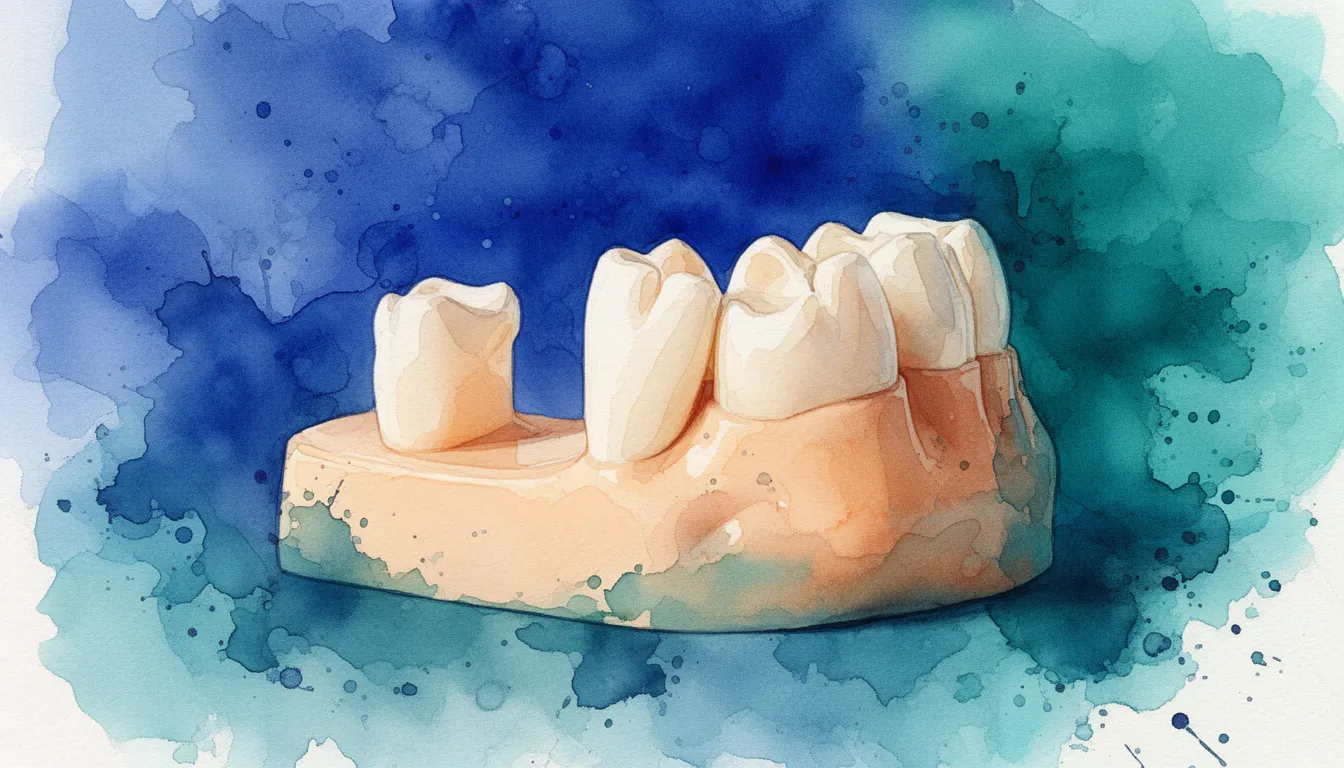
What Dental Bone Graft Materials Are
A dental bone graft is a biomaterial placed in a jawbone defect to rebuild lost bone volume. The graft acts as a scaffold that your body gradually replaces with native bone tissue[10].
Periodontists and oral surgeons use bone grafts to restore ridge height before implants, treat bone defects caused by periodontal disease, and preserve the socket after a tooth extraction. Bone loss in the jaw is common after tooth loss, infection, or trauma, and grafting is often the only way to restore enough bone for stable implant placement[3].
Graft materials fall into four broad categories based on their source: autograft (your own bone), allograft (human donor bone), xenograft (animal bone), and alloplast (synthetic). Each has a different mix of three properties that drive healing: osteogenesis (the ability to form new bone from living cells), osteoinduction (the ability to recruit stem cells), and osteoconduction (the ability to act as a scaffold)[10].
Learn more about who performs these procedures on the periodontics page.
How Bone Graft Materials Work in the Body
Bone grafts work by providing a framework for your body's own cells to grow into and form new bone. The graft is gradually broken down and replaced through a process called remodeling[10].
Healing happens in three overlapping phases. First, blood vessels grow into the graft, bringing oxygen and stem cells. Next, bone-forming cells called osteoblasts deposit new bone matrix on the scaffold surface. Finally, the original graft material resorbs while mature bone takes its place. The full cycle typically takes four to nine months before the site is dense enough to support a dental implant[3].
Three biological properties drive how well a material performs. Osteogenic materials contain living cells that directly form new bone, a property unique to fresh autografts. Osteoinductive materials release growth factors that recruit stem cells and signal them to become bone cells. Osteoconductive materials simply provide a physical scaffold for in-growing bone. Most graft materials are primarily osteoconductive, while autografts offer all three properties[10].
Clinical Applications of Bone Graft Materials
Bone grafts are used whenever the jawbone needs to be rebuilt, repaired, or preserved. The four most common uses in dentistry are socket preservation, ridge augmentation, sinus lifts, and periodontal defect repair[5].
Socket Preservation After Extraction
When a tooth is removed, the surrounding bone begins to shrink within weeks. Socket preservation places graft material into the empty socket to limit this resorption and maintain bone volume for future implant placement[5].
Ridge preservation reduces dimensional bone loss compared with extraction alone and is generally considered cost-effective when implant placement is planned[5].
Ridge Augmentation Before Implants
If the jaw has already lost significant width or height, the ridge must be rebuilt before an implant can be placed. Block grafts, particulate grafts under a membrane, or combination techniques add bone to deficient sites[1].
Combining particulate grafts with a fibrin matrix, sometimes called sticky bone, has shown promising handling and healing characteristics across a range of alveolar defects in recent reviews[1].
Sinus Floor Elevation
When the upper back jaw lacks the vertical bone needed for implants, a sinus lift raises the sinus membrane and packs graft material beneath it. Xenografts and synthetic ceramics are common choices because they resorb slowly and hold the space well during healing[3].
Periodontal Defect Repair
Advanced gum disease can destroy the bone around tooth roots. Graft materials, often combined with barrier membranes and growth factors, help regenerate lost attachment in well-contained defects. General information about gum disease is available from the American Academy of Periodontology[11].
Evidence and Effectiveness
Research generally shows that all four categories of graft material can support successful new bone formation and implant survival, though outcomes vary by site, defect size, and patient factors[3].
A 2024 retrospective study comparing different graft materials at dental implant sites reported high implant survival rates across material types, while identifying patient and site factors that influenced marginal bone loss[3]. A separate 2024 analysis found that compromised bone health can influence graft outcomes, suggesting that systemic factors deserve attention during planning[4].
FDA regulates bone graft products as medical devices. Most allografts, xenografts, and synthetic grafts used in dentistry reach the market through FDA clearance, which means the product is substantially equivalent to a legally marketed device. This is different from FDA approval, which requires a more rigorous premarket review. Patients should ask their surgeon which specific product is being used and review the manufacturer's documentation.
Professional bodies including the American Academy of Periodontology recognize bone grafting as a standard treatment for periodontal defects and ridge reconstruction[11]. Systematic reviews continue to refine which materials work best for which indications, with growing interest in synthetic ceramics that combine controlled resorption with a strong osteoconductive scaffold[6][7].
Benefits and Limitations of Each Material
No single graft material is best for every case. Each type offers a different trade-off between biological activity, handling, cost, and donor site morbidity[10].
Autograft Advantages and Limitations
Autograft is harvested from the patient, often from the chin, the back of the lower jaw, or the hip for larger cases. Because it contains living osteogenic cells, growth factors, and a natural scaffold, it offers the most complete biological package[10].
The trade-off is a second surgical site, which adds operating time, post-operative discomfort, and a small risk of donor-site complications. The volume that can be harvested intraorally is also limited, which restricts autograft use to small and medium-sized defects[8].
Allograft Advantages and Limitations
Allograft is processed bone from human donors, supplied as freeze-dried, demineralized, or mineralized particles. It avoids the need for a second surgery and is available in large quantities, which makes it a workhorse material in implant dentistry[10].
Allograft is osteoconductive and, in demineralized forms, can be osteoinductive. It does not contain living cells. Processing removes essentially all viable cells and reduces disease transmission risk, although the theoretical risk is not zero[10].
Xenograft Advantages and Limitations
Xenograft, typically derived from bovine or porcine bone, is processed to remove all organic material, leaving a mineral scaffold that closely resembles human bone. It is widely used in sinus lifts and ridge preservation because it resorbs very slowly and holds space well[3].
The slow resorption that makes xenograft useful in some sites can be a drawback in others, since residual graft particles can remain in the tissue for years. Xenograft has no osteogenic or strong osteoinductive properties on its own[10].
Synthetic Material Advantages and Limitations
Alloplastic materials include calcium phosphate ceramics such as hydroxyapatite and tricalcium phosphate, bioactive glasses, and polymer-based scaffolds[6][7]. They carry no risk of disease transmission, are available in large volumes, and can be engineered for specific resorption rates.
Synthetic grafts are primarily osteoconductive. Newer formulations aim to mimic the structure of natural bone and, in some cases, release ions or growth factors that support healing[6]. Long-term clinical data for newer formulations is still building, so material selection should consider the strength of evidence for the specific product.
Possible Complications
Across all graft types, possible complications include wound dehiscence (incision opening), infection, graft exposure, partial graft loss, and sinus membrane perforation during sinus lifts. Classifications and management of these complications are described in detail in recent periodontal literature[8].
Cost and Availability
Dental bone graft procedures commonly range from about $300 to $3,000 per site. Costs vary by location, provider, and case complexity. The wide range reflects differences in material, graft volume, the need for membranes or growth factors, and whether the graft is combined with other surgeries[5].
Socket preservation at a single extraction site sits at the lower end of that range. Larger ridge augmentations, block grafts, and sinus lifts sit at the higher end. Materials with stronger biological activity, such as growth-factor combinations, typically add to the cost. Ridge preservation has been examined as a cost-effective intervention in many implant cases because it can reduce the need for more complex grafting later[5].
Dental insurance coverage for bone grafts varies. Some plans cover grafts done for medically necessary reasons, such as periodontal regeneration, while excluding grafts done solely to support elective implants. Many patients pay out of pocket or use financing. Ask your office for a written treatment plan with itemized codes before scheduling. The American Dental Association's MouthHealthy site offers general patient resources on dental procedures and benefits[12].
Finding a Provider and Questions to Ask
Most bone grafts in dentistry are placed by periodontists or oral and maxillofacial surgeons. Some general dentists with advanced training place simple grafts at the time of extraction. For complex ridge augmentation or sinus lifts, a specialist is the typical choice.
- Which graft material do you recommend for my case, and why?
- What are the alternatives, including doing nothing or a different material?
- Will you use a barrier membrane or growth factors, and how do they change the result?
- What is the expected healing time before an implant can be placed?
- What complication rates do you see in your practice with this technique?[8]
- Will you provide the manufacturer name and lot number for the graft material used?
- What is the itemized cost, and which portions may be covered by medical or dental insurance?
Find a Specialist for Your Bone Graft
Bone grafting is a routine but technique-sensitive procedure, and the right specialist will match the material and method to your specific defect and goals. Use our directory to find a board-certified periodontist or oral surgeon in your area and bring the questions above to your consultation.
Search Periodontists in Your Area