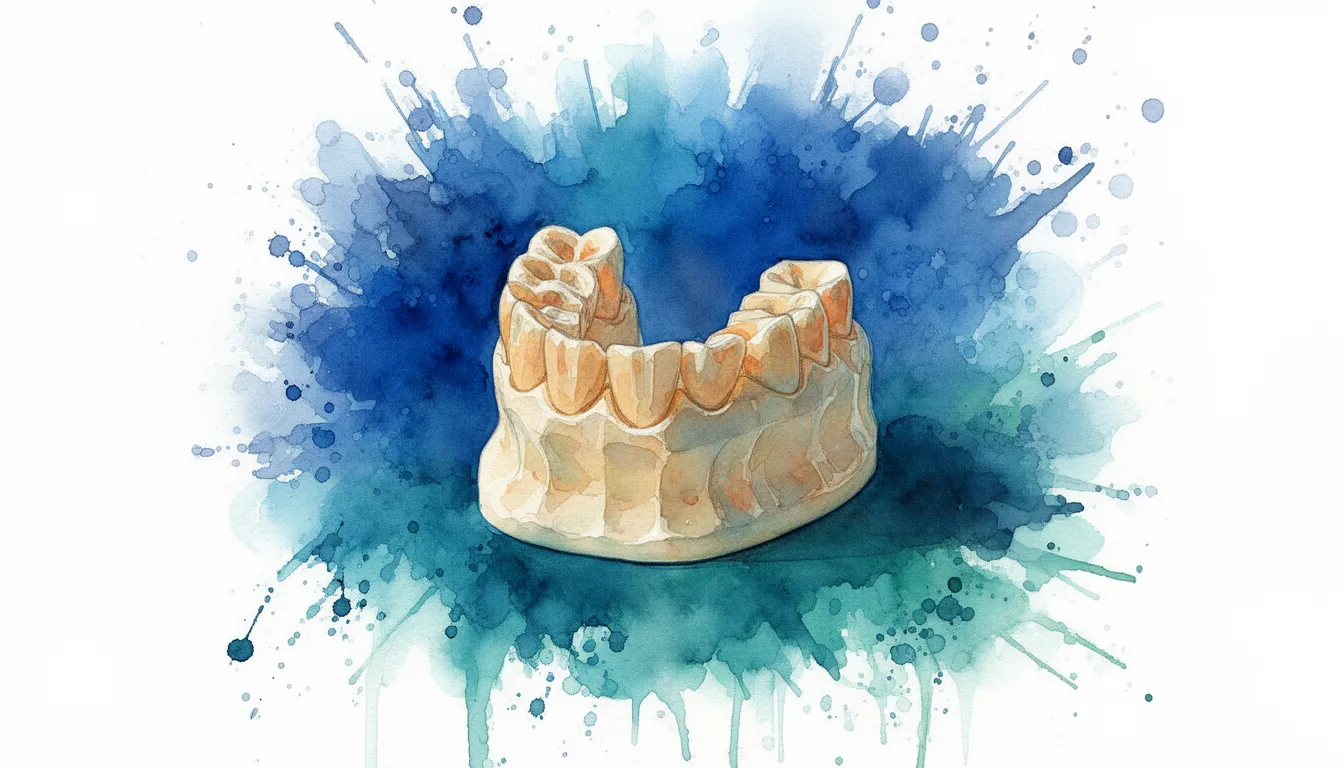
Overview: What 3D Printing in Dentistry Means
3D printing in dentistry is a process that builds custom dental devices layer by layer from a digital design file. Instead of carving or milling a device from a solid block, a printer adds material one thin layer at a time until the final shape is complete.[2]
The technology is also called additive manufacturing. Dental teams use it to produce items like surgical guides for implants, models for clear aligners, temporary crowns, full and partial dentures, and night guards. Each piece is shaped to fit a specific patient based on a digital scan of the mouth.[1][2]
3D printing rarely works alone. It is one step in a larger digital workflow that includes intraoral scanning, computer-aided design (CAD), and computer-aided manufacturing (CAM). Together, these tools let a dentist or specialist move from scan to finished device without traditional putty impressions or hand-shaped wax models in many cases.[2][3]
How 3D Printing Works in a Dental Office
Dental 3D printing turns a 3D digital design into a physical device by hardening or fusing thin layers of material. The printer reads the design file and builds the device one cross-section at a time, typically in resin, ceramic, or metal.[2]
The most common dental printers use light-based resin processes. In stereolithography (SLA) and digital light processing (DLP), a laser or projector cures a liquid resin into a solid shape, layer by layer. These processes are well suited to small, detailed objects like crowns, guides, and splints.[2]
For metal parts such as implant frameworks or partial denture bases, dental labs may use selective laser melting (SLM) or selective laser sintering (SLS). These printers fuse fine metal powder with a high-powered laser to create dense, strong structures.[2][3]
From Mouth Scan to Finished Device
A typical digital workflow starts with an intraoral scan of the teeth and gums. The scan is imported into CAD software, where the clinician or technician designs the device, such as a crown, aligner model, or surgical guide. The design file is then sent to the 3D printer.[2]
After printing, devices usually need post-processing. This can include washing off uncured resin, curing under additional light, removing supports, and polishing. For metal parts, post-processing may also include heat treatment and finishing.[2][3]
Materials Used in Dental 3D Printing
Materials used in dental 3D printing include biocompatible resins for models, guides, splints, and provisional restorations, as well as ceramics and certain metals for definitive restorations and frameworks. Material choice depends on the device, how long it will stay in the mouth, and the forces it must handle.[2][3]
- Resins: used for models, surgical guides, occlusal splints, denture bases and teeth, and temporary crowns.[1][2]
- Ceramics: being developed and used for certain restorations, with ongoing research into long-term durability.[2]
- Metals (titanium, cobalt-chromium): used for implant components, partial denture frameworks, and craniomaxillofacial structures.[2][3]
Clinical Applications in Dentistry
3D printing is used across many areas of dentistry, including implant surgery, orthodontics, prosthodontics, and oral and maxillofacial procedures. Each application uses the same basic process but with different materials and design goals.[1][2][3]
Surgical Guides for Dental Implants
A surgical guide is a custom-printed device that fits over the teeth or gums and directs the drill to a planned implant position. It is designed from a CBCT scan and a digital impression, so the implant location and angle are planned before surgery.[2][4]
Research on additive manufacturing in dentistry reports that printed surgical guides can support more predictable implant placement compared to freehand techniques, though accuracy still depends on guide design, fit, and surgical technique.[4]
Orthodontics and Clear Aligners
In orthodontics, 3D printing is widely used to produce models of the teeth at each stage of treatment. Clear aligners are typically thermoformed over these printed models, allowing a series of trays that move teeth gradually. Printed retainers and indirect bonding trays for brackets are also common.[2]
Crowns, Bridges, and Dentures
Prosthodontists and general dentists use 3D printing for working models, temporary crowns and bridges, try-in dentures, and final denture bases and teeth made from approved resins. For long-term restorations such as final crowns, milling from ceramic blocks is still common, but printable ceramic materials are an active area of research.[2]
For complex cases like full-arch restorations, digital design and 3D-printed components allow careful planning of tooth position, bite, and esthetics before any permanent restoration is placed. You can learn more about restorative care on the prosthodontics page.[2]
Night Guards and Occlusal Splints
Occlusal splints and night guards are commonly produced with 3D printing using clear, biocompatible resins. A review of printed splints reports that they can be designed and produced efficiently from digital scans and may offer accurate fit, with ongoing study of long-term wear and mechanical properties.[1]
Surgical Models and Maxillofacial Reconstruction
For oral, maxillofacial, and craniofacial surgery, printed anatomical models help surgeons plan complex procedures and pre-bend plates before the operation. Patient-specific cutting guides, splints, and implants are also being used in orthognathic and reconstructive cases.[3][5]
A literature review of 3D printing in orthognathic surgery describes uses including model surgery, custom splints, and cutting guides, and notes that these tools may shorten operating time and improve accuracy of planned movements.[5]
Evidence and Effectiveness
Evidence for dental 3D printing comes from a mix of laboratory accuracy studies, clinical reports, and systematic reviews. Overall, research suggests that printed devices can meet clinical accuracy needs for many indications when proper materials, design, and post-processing steps are used.[2][4]
FDA Clearance vs. Approval
Many dental 3D printers, materials, and printed devices in the U.S. reach the market through FDA clearance under the 510(k) pathway. Clearance means the device is considered substantially equivalent to one already on the market. This is different from FDA approval, which is a stricter pathway used for higher-risk devices.[2]
Patients can ask whether the specific printer, resin, or printed device used in their treatment is cleared by the FDA for that intended use. Manufacturers often publish this information in product documentation.[2]
Accuracy and Outcomes Research
Research on the accuracy of additive manufacturing in stomatology has examined how closely printed models, guides, and restorations match their digital designs. These studies suggest that accuracy is generally clinically acceptable for many uses, with results that depend on the printing technology, material, layer thickness, and post-processing.[4]
Reviews of printed splints and patient-specific devices report that 3D-printed appliances can match or approach the accuracy of conventional methods in many cases, while also noting that long-term clinical studies are still needed for some applications.[1][2]
Professional Society Context
Patient-facing resources from groups like the American College of Prosthodontists and the American Dental Association describe digital workflows, including 3D printing, as part of modern dental care. They encourage patients to discuss device materials, lab sources, and follow-up care with their dentist.[6][7]
Benefits and Limitations
3D printing offers speed, customization, and digital integration, but it is not the right tool for every dental device. Honest comparison with traditional methods like milling and lab fabrication helps set realistic expectations.[2][3]
Potential Benefits
Reported benefits include faster turnaround for many devices, custom fit driven by patient-specific data, and a workflow that can reduce the number of conventional impressions. For surgical cases, planning with 3D-printed guides and models may also improve predictability of complex procedures.[2][3][5]
- Custom devices designed from each patient's own scans.[2]
- Same-day or next-day production of certain devices, such as guides, models, and temporaries.[2]
- Fewer or no putty impressions when intraoral scanning is used.[2]
- Digital files can be re-used to remake lost or broken appliances.[2]
- Better visualization and planning in implant and reconstructive cases.[3][5]
Limitations and Trade-Offs
Limitations include the strength and long-term wear behavior of some printable materials, equipment and training costs for offices and labs, and the need for careful post-processing. For very high-strength definitive restorations, milled ceramics or metal frameworks are still commonly preferred, though printable ceramics are advancing.[2]
- Not all materials are suitable for permanent, load-bearing restorations.[2]
- Quality depends on calibration, support design, washing, and curing steps.[2]
- Long-term clinical data is still limited for some newer printed devices.[1][2]
- Office adoption requires investment in printers, software, and staff training.[2][3]
Cost and Availability
Patient costs for 3D-printed dental devices typically appear as part of the overall fee for the treatment, not as a separate line item. Costs vary by location, provider, and case complexity.[2]
Whether a printed device costs more, less, or the same as a conventional one depends on the procedure, the materials, and whether the printing is done in-office or at a dental lab. For example, the price of a surgical guide, a clear aligner case, or a denture is influenced by the underlying treatment, not just the printing step itself.[2][6]
Insurance coverage usually follows the procedure code rather than the manufacturing method. A crown or denture covered by a plan is generally covered whether it is milled, printed, or made traditionally. Patients should check their plan benefits and ask their office for a written estimate before treatment.[6][7]
Finding a Provider Who Uses 3D Printing
Many general dentists and specialists now use 3D printing in some form, often together with intraoral scanning. Patients can ask direct questions to learn how the technology will be used in their care and what to expect.[2][6]
- Which parts of my treatment will use 3D-printed devices, and which will use traditional methods?
- What material will the device be made from, and is it FDA cleared for this use?[2]
- Is the device printed in-office or at a dental lab?
- How long will the device be expected to last, and what is the plan if it breaks?
- Will my treatment use a fully digital workflow with intraoral scanning, or will conventional impressions still be needed?[2]
- How are my digital files stored and protected?
- What is the total cost estimate, and how does my insurance apply?[6][7]
Find a Specialist
If you are considering treatment that may involve 3D-printed devices, such as implants, full-arch restorations, dentures, or complex prosthetic work, talk with a specialist who uses a digital workflow. Visit the prosthodontics page to learn more about restorative specialists and how to find one in your area.
Search Prosthodontists in Your Area