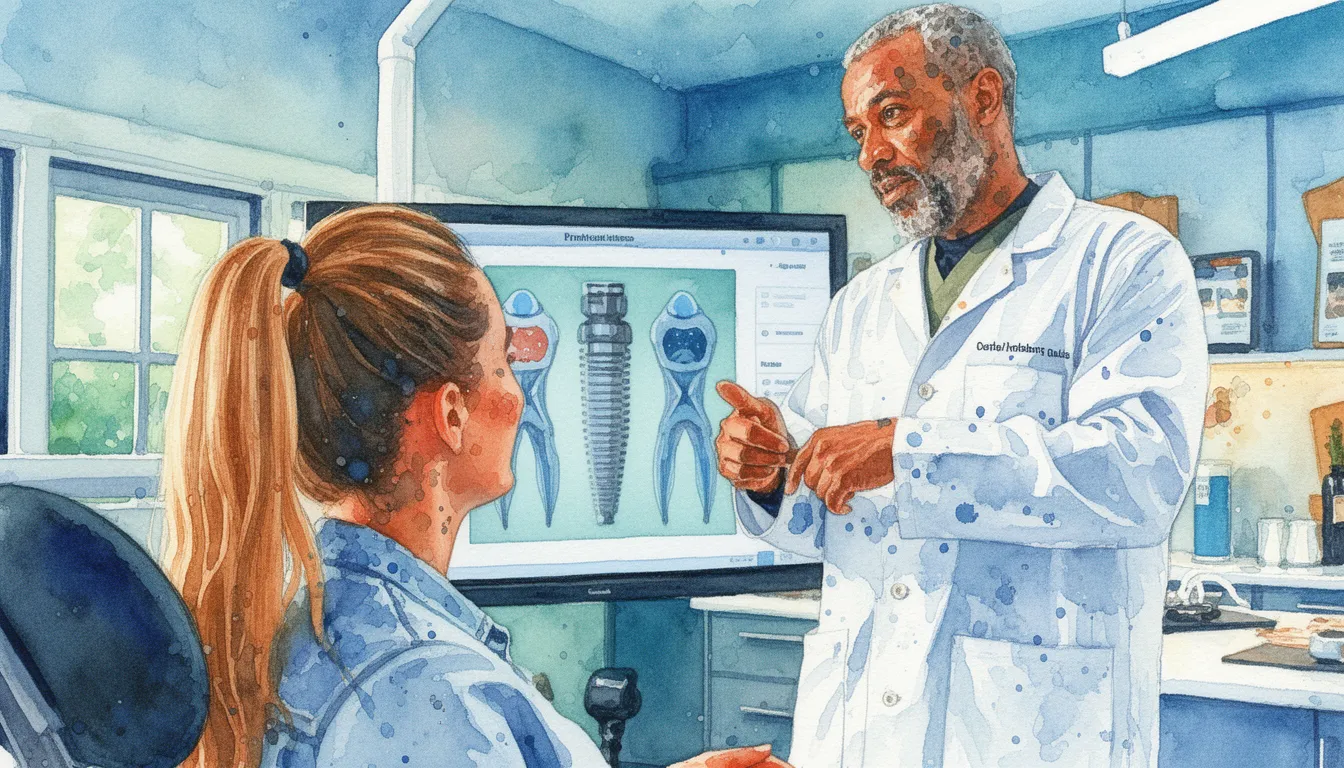
What This Guide Covers and Who It Is For
This guide explains everything you need to know about dental implants, from how they work to what they cost.
Dental implants are the closest replacement to a natural tooth. Unlike dentures that sit on your gums or bridges that rely on neighboring teeth, implants anchor directly into your jawbone. This gives them stability that other options cannot match.
This resource is for anyone missing one or more teeth, considering tooth replacement, or comparing implants to other options like bridges or dentures. It is also helpful if you have already been told you need an implant and want to understand the process before your first appointment.
Whether you are missing a single tooth from an injury or need to replace a full arch of teeth, implants may be an option worth exploring with a qualified specialist.
How Dental Implants Work
A dental implant is a small titanium post that a specialist surgically places into your jawbone to act as an artificial tooth root.
The Three Parts of a Dental Implant
Every dental implant system has three main components. Understanding each part helps you follow conversations with your dental team.
The first part is the implant itself. This is a small screw-shaped post made of titanium or titanium alloy. Titanium is biocompatible, meaning your body accepts it without rejection. The post is placed directly into the jawbone, where it serves as the root of your new tooth.
The second part is the abutment. This is a connector piece that attaches to the top of the implant post after healing. It sits at or just above the gum line and holds the final restoration in place.
The third part is the prosthesis, which is the visible tooth. For a single missing tooth, this is usually a porcelain or ceramic crown. For multiple missing teeth, it may be a bridge or a full denture secured to several implants. [2]
Types of Dental Implants
Most patients receive endosteal implants. These are placed directly into the jawbone and are the most common type used today. [2]
Subperiosteal implants sit on top of the jawbone beneath the gum tissue. These are used in rare cases where a patient does not have enough bone height and cannot undergo bone grafting. They are far less common than endosteal implants.
Zygomatic implants anchor into the cheekbone (zygoma) instead of the upper jawbone. They are reserved for patients with severe bone loss in the upper jaw. This is a specialized procedure performed by experienced oral surgeons or prosthodontists.
Single Tooth, Multiple Teeth, and Full Arch Options
Implants can replace one tooth, several teeth, or an entire arch. The approach depends on how many teeth you are missing and where they are located.
A single implant with a crown replaces one missing tooth. Each implant stands on its own without affecting neighboring teeth. This is a key advantage over a traditional bridge, which requires grinding down healthy teeth on either side of the gap.
An implant-supported bridge replaces several teeth in a row using two or more implants as anchors. This avoids the need for one implant per missing tooth, which reduces cost and surgery.
Full arch replacement uses four to six implants to support a complete set of upper or lower teeth. This option is sometimes called an implant-supported denture or fixed hybrid prosthesis. It gives patients a stable, non-removable set of teeth. A prosthodontist typically designs and manages these complex restorations. [1]
Osseointegration: How the Implant Bonds to Bone
Osseointegration is the biological process where your jawbone grows around and bonds to the titanium implant. This is what gives implants their strength and stability.
After the implant post is placed, your bone cells begin attaching to the titanium surface. This process typically takes 3 to 6 months, depending on the location in your mouth and your overall health. The lower jaw often heals faster than the upper jaw because the bone is denser.
Successful osseointegration is the foundation of a long-lasting implant. Factors that support healing include adequate bone density, good blood supply, and avoiding smoking during recovery.
What You Need to Know Before Getting Implants
Most healthy adults with adequate jawbone are good candidates for dental implants.
Who Is a Good Candidate
The ideal candidate has healthy gums, enough jawbone to support the implant, and good overall health. Your specialist will evaluate all of these factors before recommending treatment.
Age is generally not a barrier for adults. Implants are placed in patients ranging from their early twenties to their eighties and beyond. However, implants are typically not recommended for adolescents whose jaws are still growing. Your specialist may recommend waiting until jaw growth is complete, usually around age 18 for women and 21 for men.
Certain medical conditions require careful evaluation. Uncontrolled diabetes, autoimmune disorders, and radiation therapy to the head or neck area may affect healing. These conditions do not automatically rule out implants, but they require close coordination between your specialist and your physician.
Bone Loss and Bone Grafting
Jawbone loss is common after tooth extraction. Without the stimulation of a tooth root, bone gradually shrinks over time. This is called resorption.
If you do not have enough bone to support an implant, your specialist may recommend a bone graft. This procedure adds bone material to the deficient area and allows new bone to grow. Grafting material can come from your own body, a donor source, or a synthetic substitute.
A sinus lift is a specific type of bone graft for the upper back jaw. It raises the sinus floor and adds bone beneath it. Bone grafts typically need 3 to 6 months to heal before the implant can be placed, which adds time to the overall process.
Smoking and Other Risk Factors
Smoking significantly increases the risk of implant failure. Tobacco restricts blood flow to the gums and bone, which slows healing and weakens osseointegration.
Most specialists strongly advise quitting smoking before and after implant surgery. If you smoke, discuss this honestly with your specialist. They can help you understand the risks and may suggest a timeline for quitting before your procedure.
Other risk factors include teeth grinding (bruxism), heavy alcohol use, and poor oral hygiene. If you grind your teeth, your specialist may recommend a night guard to protect the implant and crown after placement.
What to Expect: The Dental Implant Process Step by Step
The implant process involves several stages spread over 3 to 9 months, depending on your treatment plan.
Step 1: Consultation and Treatment Planning
Your first visit includes a thorough exam, dental X-rays, and often a 3D cone beam CT scan. The scan creates a detailed image of your jawbone, nerves, and sinuses. This helps your specialist determine exactly where to place the implant.
Your specialist will review your medical history, discuss your goals, and explain your options. If bone grafting or other preparatory procedures are needed, they will outline those steps as well. A detailed treatment plan with estimated costs and timeline is typically provided at this stage.
Step 2: Implant Placement Surgery
Implant surgery is typically performed under local anesthesia, meaning the area is numbed but you remain awake. Sedation options such as oral sedation or IV sedation are available for patients who feel anxious.
Your specialist makes a small incision in the gum tissue, drills a precise channel in the jawbone, and threads the implant post into place. The gum is then closed over or around the implant. The entire procedure for a single implant usually takes 30 to 60 minutes.
Most patients report that the procedure is less painful than they expected. The discomfort is often compared to a tooth extraction.
Step 3: Healing and Osseointegration
After surgery, your body needs time to heal and allow osseointegration to occur. This phase typically lasts 3 to 6 months.
During healing, you may wear a temporary tooth or partial denture so you are not without a visible tooth. Your specialist will give you specific instructions about diet, oral hygiene, and activity restrictions. Soft foods are recommended for the first week or two.
Follow-up visits allow your specialist to monitor healing. Most patients return to normal activities within a day or two of surgery, though some soreness and swelling is normal for the first few days.
Step 4: Abutment and Crown Placement
Once osseointegration is confirmed, your specialist attaches the abutment to the implant. This is a minor procedure that may require a small incision if the gum has healed over the implant.
After the gum tissue heals around the abutment (usually 2 to 4 weeks), impressions or digital scans are taken to fabricate your final crown. The crown is custom-made to match the shape, size, and color of your surrounding teeth.
The crown is then secured to the abutment, either with a tiny screw or with dental cement. At this point, you have a fully functional replacement tooth.
Long-Term Care and Maintenance
Implants require the same daily care as natural teeth. Brush twice a day, floss daily, and see your dentist for regular checkups and cleanings. [2]
While the titanium post itself cannot develop cavities, the gum and bone around it are still vulnerable to infection. Peri-implantitis is a condition similar to gum disease that affects the tissue around an implant. It is the most common cause of late implant failure and is usually preventable with good hygiene and regular professional cleanings.
The implant post can last a lifetime in many cases. The crown, however, may need replacement after 10 to 15 years due to normal wear. Your specialist will monitor the implant at your regular appointments.
Dental Implant Costs and Insurance
A single dental implant typically costs between $3,000 and $5,000, including the post, abutment, and crown. Costs vary by location, provider, and case complexity.
What Drives the Cost
Several factors influence the total price of implant treatment. The number of implants, the type of restoration, and any preparatory procedures like bone grafting all affect cost.
A single implant with a crown is the simplest scenario. An implant-supported bridge replacing three or four teeth may cost $6,000 to $12,000. Full arch replacements using four to six implants with a fixed prosthesis typically range from $20,000 to $50,000 or more per arch. Costs vary by location, provider, and case complexity.
Additional costs may include the initial consultation, 3D imaging, bone grafts ($500 to $3,000 per site), sinus lifts ($1,500 to $3,000), sedation, and temporary teeth during the healing phase. Ask for a written breakdown of all fees before starting treatment.
Insurance Coverage and Payment Options
Dental insurance coverage for implants has improved in recent years, but policies vary widely. Some plans cover a portion of the implant or the crown but not both. Others classify implants as a cosmetic procedure and provide no coverage.
Review your plan carefully and ask your specialist's office to submit a pre-authorization to your insurance company. This gives you a clearer picture of your out-of-pocket cost before treatment begins.
Many specialist offices offer payment plans or financing through third-party companies. Health savings accounts (HSAs) and flexible spending accounts (FSAs) can also be used to pay for implant treatment with pre-tax dollars.
When to See a Specialist for Dental Implants
You should see a specialist whenever you are replacing a missing tooth, evaluating bone loss, or considering full arch restoration.
While some general dentists place implants, three dental specialties have advanced training specifically relevant to implant treatment. Oral surgeons specialize in the surgical placement of implants, particularly in complex cases involving bone grafting, sinus lifts, or medically compromised patients. Periodontists focus on the gums and bone that support teeth, making them well-suited for patients with gum disease or bone deficiency. Prosthodontists specialize in the design and restoration of replacement teeth, including the crowns, bridges, and full arch prostheses that attach to implants. [1]
Consider seeing a specialist if you have significant bone loss, need multiple implants, have a medical condition that complicates healing, or want a full arch replacement. Complex cases often benefit from a team approach where a surgeon places the implant and a prosthodontist designs and delivers the final restoration.
If your general dentist has recommended an implant, asking for a referral to a specialist is a reasonable step. A specialist can confirm the treatment plan, identify potential complications early, and often has more experience managing difficult cases.
Find a Dental Implant Specialist Near You
Choosing the right specialist is one of the most important decisions in your implant treatment. Look for a board-certified prosthodontist, periodontist, or oral surgeon with experience in cases similar to yours. You can browse specialists by location and specialty on the prosthodontics page at My Specialty Dentist to find qualified providers in your area. Ask about their training, the number of implants they place each year, and whether they use digital planning technology.
Search Prosthodontists in Your Area