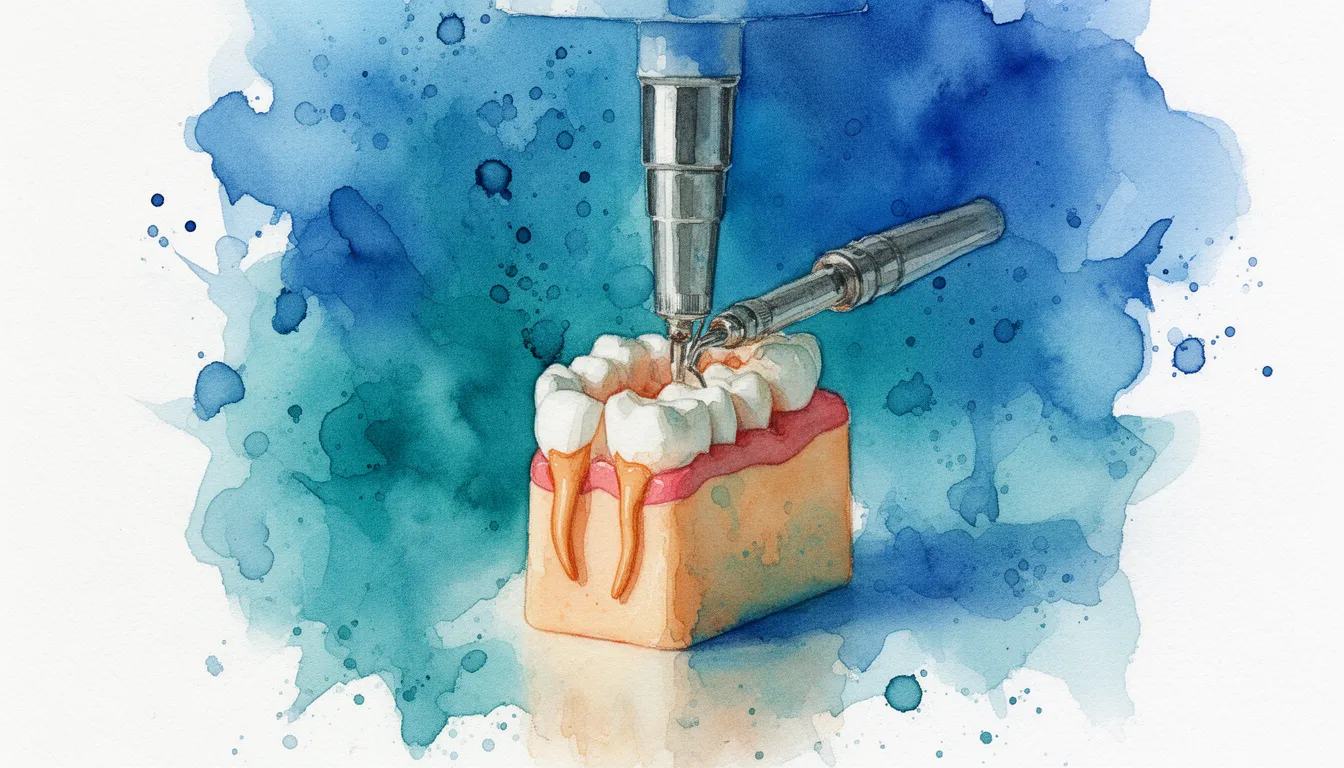
What Is a Dental Operating Microscope?
A dental operating microscope is a high-powered surgical microscope mounted on an arm above the patient. It gives the endodontist magnified, brightly lit views of the inside of a tooth during root canal treatment.[4]
The device combines optical lenses, coaxial light, and a stable mount. The light travels along the same path as the view, so shadows do not block the working area. The endodontist sees fine details that the unaided eye cannot resolve, including tiny canal openings, cracks, and remnants of infected tissue.[2][4]
Microscopes were introduced into endodontics in the 1990s. Today, professional bodies including the American Association of Endodontists treat the microscope as part of routine specialty practice for diagnosis, treatment, and surgical procedures.[8][11]
How the Microscope Works in a Root Canal
The dental microscope magnifies the tooth, lights the canal system, and lets the endodontist work with controlled precision. It does not deliver any treatment on its own; it improves what the clinician can see and do.[4]
Magnification typically ranges from about 3x at low power to 30x at high power. Lower settings are used for orientation and access. Higher settings are used to inspect canal walls, locate small openings, and check the quality of cleaning and filling.[4][10]
Coaxial illumination is the key optical feature. Light is delivered through the same lens system the clinician looks through, so the beam reaches the bottom of a narrow canal without being blocked by the operator's hand or by instruments. The result is a bright, shadow-free working field.[4]
Magnification Levels and Their Use
Endodontists switch between magnification ranges during a single appointment. Low power (about 3x to 8x) is used for general orientation, access cavity preparation, and rubber dam placement. Mid-range (about 10x to 16x) is used to locate canal openings and inspect the pulp chamber floor. High power (about 20x to 30x) is reserved for fine work such as identifying calcified canals, finding cracks, or removing separated instruments.[2][4]
Ergonomics and Documentation
The microscope also supports a seated, upright posture, which helps the clinician work for longer periods with more steady hands. Many systems include cameras that record video or still images, so findings can be shown to the patient and documented in the chart.[8]
When Endodontists Use the Microscope
Endodontists use the microscope for most stages of root canal treatment, retreatment, and surgery. Magnification is most valuable when anatomy is complex, calcified, or hidden under existing dental work.[2][4][8]
Initial Root Canal Treatment
During a first-time root canal, the microscope helps the endodontist make a conservative access opening, find every canal, and remove infected pulp tissue. A 2025 retrospective cohort study of microscope-assisted root canal treatment in permanent posterior teeth reported favorable healing and tooth survival outcomes compared with standard care.[4]
Magnification also supports minimally invasive techniques. Conservative access cavity protocols, which preserve more natural tooth structure, are easier to perform when the canal openings can be seen clearly.[10] A randomized clinical trial in 2025 found that minimally invasive root canal treatment produced healing outcomes comparable to traditional approaches.[3]
Calcified and Hidden Canals
Canals can narrow or close off due to age, trauma, or long-standing inflammation. A 2025 systematic review of case reports on the management of calcified canals highlights the role of magnification and careful instrumentation in locating and negotiating these canals safely.[2]
Without magnification, the clinician may perforate the tooth while searching for a calcified canal. With the microscope, small landmarks on the pulp chamber floor become visible and guide the path to the canal opening.[2]
Root Canal Retreatment
If a previous root canal has failed, the endodontist may need to remove old filling material, posts, or separated instruments before retreating the tooth. The microscope is central to this work because every step happens inside a narrow space already filled with dense material.[8]
Endodontic Microsurgery (Apicoectomy)
When a root canal cannot be retreated through the crown, the endodontist may perform an apicoectomy, removing the tip of the root and sealing it from the outside. Modern endodontic microsurgery combines the microscope with ultrasonic tips and bioceramic root-end filling materials. A 2022 review on the present status of surgical endodontics reports that contemporary microsurgical techniques produce substantially higher success rates than older root-end surgery approaches.[8]
Evidence and Professional Recommendations
Research and professional consensus support routine use of the microscope in endodontic care. Dental operating microscopes are regulated medical devices that have been marketed in the United States under FDA clearance, not approval; clearance means they are substantially equivalent to predicate devices on the market.
A 2025 retrospective cohort study published in the Journal of Dentistry examined microscope-assisted root canal treatment in permanent posterior teeth and reported improved clinical outcomes compared with non-microscope-assisted care.[4] A 2025 systematic review of case reports on calcified canal management points to magnification as a recurring success factor in difficult cases.[2]
For surgical endodontics, a 2022 Setzer et al. review in the International Endodontic Journal concludes that modern microscope-based microsurgical protocols have replaced older traditional root-end surgery, with markedly better outcomes when proper case selection, magnification, and bioceramic materials are used.[8]
Professional societies reinforce this position. The American Association of Endodontists describes the microscope as standard in specialty practice and publishes patient education materials explaining its role.[11]
What the Evidence Does Not Claim
Magnification is one factor among several. Treatment success also depends on accurate diagnosis, thorough disinfection of the canal system, sealing the canal well, and timely restoration of the tooth.[5][9] Research on irrigation methods, instrumentation, and sealing materials continues to refine what works best.[1][6][7][9] A microscope helps the clinician execute these steps more precisely, but it does not replace any of them. Results vary by case complexity, tooth anatomy, and the health of the surrounding tissues.
Benefits and Limitations
The microscope offers clear clinical advantages but is not a guarantee of success. Understanding its benefits and limits helps patients weigh treatment options.
Advantages
The main advantages are visibility and precision. Magnification reveals canal openings, cracks, and remnants of pulp tissue that would otherwise be missed.[2][4] Coaxial light keeps the working field bright at the bottom of the canal.[4] The microscope also supports conservative access cavity techniques, which preserve more natural tooth structure during treatment.[10]
Microsurgical procedures particularly benefit from magnification. A 2022 review reports that microscope-based apicoectomy with modern bioceramic root-end fillings has replaced older root-end surgery techniques because of substantially better outcomes.[8]
Limitations
The microscope does not change the underlying biology of healing. Severely fractured teeth, advanced periodontal disease, or systemic conditions may still lead to treatment failure regardless of magnification.[8]
There is also a learning curve. Working under high magnification requires hand-eye coordination through indirect vision and an assistant trained to support the procedure.[8] Not every general dentist owns or uses a microscope, which is one reason complex cases are often referred to an endodontist.[11]
Cost, Availability, and Insurance
Patients usually do not pay a separate fee for microscope use. The cost is part of the overall root canal or microsurgery fee, which varies by tooth, case complexity, and provider. Costs vary by location, provider, and case complexity.
Root canal fees are typically higher when performed by an endodontist than by a general dentist, in part because of the equipment, training, and time involved. Insurance plans that cover root canal treatment generally cover endodontist-performed care at similar rates, though out-of-pocket costs depend on the plan, network status, and deductible.[12]
Most board-certified endodontists in the United States use dental operating microscopes routinely.[8][11] If access to a specialist is limited, ask the general dentist whether they use magnification (microscope or surgical loupes) and whether they refer complex cases to an endodontist.
Questions to Ask Your Endodontist
A short conversation before treatment helps confirm that the right tools and techniques will be used for your case. Useful questions include the following:
- Do you use a dental operating microscope for root canal treatment, or surgical loupes only?
- What magnification levels do you use for locating canals and for fine work?
- Have you treated calcified or unusually shaped canals like mine before?
- If a retreatment or apicoectomy becomes necessary, can it be done in your office?
- Can you show me images or video from the microscope during my appointment?
- What is the expected success rate for a tooth in my situation, and what would change that estimate?
What Good Answers Look Like
A specialist who uses the microscope routinely will answer these questions directly. They should be able to describe how they used the microscope to find canals or check cleaning during past procedures. They should also be willing to give a realistic estimate of outcomes, including the chance of complications, rather than a guaranteed result.[8]
Find an Endodontist Near You
If you need a root canal, retreatment, or apicoectomy, an endodontist who routinely works under a dental operating microscope can give your tooth its best chance of long-term survival. Browse the endodontics page to find specialists, learn what to expect at your visit, and compare providers in your area.
Search Endodontists in Your Area