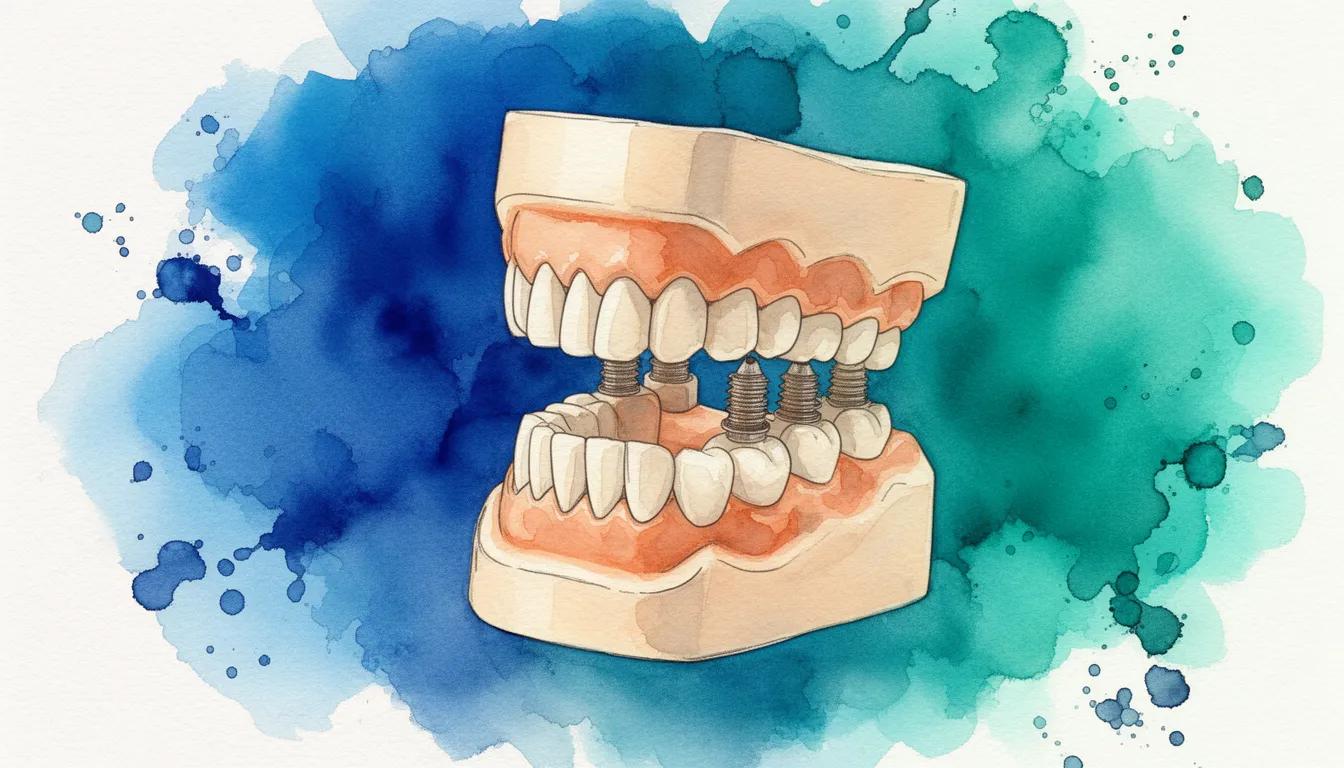
What Is a Dental Implant Surgical Guide?
A dental implant surgical guide is a custom plastic template that fits over your teeth or gums and directs each drill and implant to a pre-planned position. It turns a 3D digital plan into physical accuracy in the mouth.
The guide is built from two data sources. The first is a cone-beam CT (CBCT) scan, which shows your bone, nerves, and sinuses in three dimensions. The second is a digital impression or intraoral scan of your teeth and gums[6]. Software merges these files so the surgeon can plan exactly where each implant should sit, what size to use, and what angle to drill.
Once the plan is approved, the guide is fabricated, sterilized, and used during surgery. Sleeves built into the guide accept the surgical drills at the planned depth and angle. This is often called static computer-assisted implant surgery, in contrast to dynamic navigation systems that track instruments on a screen in real time[9].
How Surgical Guides Are Designed and Made
Surgical guides are designed digitally, then fabricated by 3D printing or milling so the drill sleeves sit at the exact angle and depth planned in software. The process takes the surgeon's plan and locks it into a physical template.
Planning starts with the CBCT and intraoral scan. The clinician uses implant planning software to choose implant length, diameter, position, and angulation around critical anatomy. Virtual patient workflows that combine CBCT with surface scans have been shown to improve planning accuracy[6].
Fabrication happens by stereolithography (a form of 3D printing) or by milling a solid block of resin. 3D printing is now the more common method because it handles complex geometries and short turnarounds well[6]. Metal sleeves are typically inserted into the printed body to guide the drills.
Tooth-Supported, Mucosa-Supported, and Bone-Supported Guides
Guides are classified by what they rest on. Tooth-supported guides clip onto remaining teeth and are usually the most accurate because teeth provide a stable reference. Mucosa-supported guides rest on the gums and are used for fully edentulous (toothless) arches. Bone-supported guides sit directly on exposed bone and are less common today[8].
Support type is one of the factors that can influence accuracy. A systematic review of stereolithographic guides identified support type, sleeve fit, and fixation pins as variables that can shift the final implant position from the plan[8].
Static Guides vs. Dynamic Navigation vs. Robotics
Static guides are the most widely used. Dynamic navigation tracks the drill on a screen in real time using optical markers, which is useful when access is limited or the plan changes during surgery[4]. Robot-assisted systems are newer and physically constrain or move the handpiece along the planned path[7].
Recent comparative work suggests robotic and static-guided approaches produce similar accuracy in many situations, with robotics offering slightly tighter precision in some measurements[1][3]. Static guides remain the most accessible option for most practices.
When Surgical Guides Are Used
Surgical guides are used across most implant scenarios today, from single missing teeth to full-arch reconstructions, and they are especially valuable when anatomy is tight or several implants must align precisely.
Single-Tooth Implants
For a single implant in an esthetic zone, a guide helps the surgeon place the implant so that the future crown emerges naturally from the gums. Even a 1 to 2 mm shift can change how the final crown looks and cleans[10].
Full-Arch and All-on-X Cases
Full-arch cases place four to six implants that must work together to support a fixed bridge. Guides help keep implants parallel enough for a single prosthesis to seat without strain[10]. Many immediate-load protocols rely on guided placement so the temporary bridge fits the same day.
Sites Near Nerves or Sinuses
When implants are planned near the inferior alveolar nerve in the lower jaw or close to the maxillary sinus in the upper jaw, guides add a safety margin. The planned trajectory is locked into the template, so the drill cannot drift into a high-risk zone[6].
What the Research Shows About Accuracy
Research demonstrates that guided implant surgery is consistently more accurate than freehand placement, with most studies reporting mean deviations from the plan in the 1 to 2 mm range at the implant tip[1][3].
A 2025 comparative study in the Journal of Dental Research examined robotic, dynamic-navigation, and static-guide approaches and found all three produced clinically acceptable precision, with measurable differences between systems[1]. A 2025 retrospective comparison between autonomous robotic placement and static guides reported similar accuracy with slightly tighter systematic precision for the robot[3].
A systematic review of dynamic navigation systems in implantology found that navigation-assisted placement reduced angular and linear deviations compared with freehand surgery across multiple in vitro studies[4]. A separate systematic review of 3D imaging and virtual patient workflows concluded that combining CBCT with surface scans improves planning accuracy and reduces intraoperative errors[6].
Patient experience research is more limited but generally positive. A 2025 study reported that patients undergoing computer-assisted implant surgery described the procedure as predictable and acceptable, with most reporting they would choose the same approach again[5].
Regulatory Status
Implant planning software and 3D-printed guide materials are regulated as medical devices. Many are FDA cleared through the 510(k) pathway, which means they were shown substantially equivalent to existing devices. FDA clearance is not the same as FDA approval, which is a higher standard typically reserved for novel high-risk devices. Ask your surgeon which planning software and guide materials they use if you want to verify regulatory status.
Benefits and Limitations Compared to Freehand Surgery
Surgical guides offer meaningful accuracy and workflow benefits over freehand placement, but they are not free of trade-offs. Understanding both sides helps you ask better questions before surgery.
Advantages
The most consistent benefit is placement accuracy. Multiple studies show smaller deviations from the planned position with guided surgery than with freehand technique[1][4].
Guided surgery can also shorten chair time once the plan is finalized. For straightforward cases, the surgeon does not need to make as many intraoperative judgments because the plan is built into the template[9]. In select cases the gum tissue does not have to be opened with a scalpel, which is called flapless surgery and may reduce swelling and recovery time[9].
Limitations
Guides are not perfect. Errors can accumulate across CBCT acquisition, scan alignment, design, fabrication, and seating of the guide in the mouth. A systematic review identified support type, sleeve tolerance, fixation, and patient mouth opening as factors that can shift the final position from the plan[8].
Guides also add upfront planning time and laboratory cost, and they require enough mouth opening for the drill plus guide sleeve. In very posterior cases with limited opening, dynamic navigation may be preferable[4]. Finally, guides rely on the quality of the original CBCT and impression. Poor data in means poor accuracy out.
Cost, Insurance, and Where Guides Are Available
Surgical guides typically add $200 to $600 to an implant case, and that fee is usually bundled into the overall treatment plan rather than billed separately. Costs vary by location, provider, and case complexity.
Insurance behavior varies. Dental plans that cover implants generally include planning and surgical fees in the implant code rather than reimbursing the guide as a separate line item. Medical insurance rarely covers implants except in specific reconstructive situations. Ask the office to walk you through the full quote line by line, including the CBCT, the guide, the implant, the abutment, and the crown.
Availability has grown quickly. Most practices that place a meaningful volume of implants now use guided workflows for at least full-arch and complex cases. Single-implant cases in less complex anatomy are sometimes still done freehand when the surgeon judges the added planning unnecessary.
Questions to Ask Your Surgeon
If you are weighing guided vs. freehand implant surgery, a focused set of questions will quickly tell you how comfortable a surgeon is with the technology and whether it is the right fit for your case.
- Will my case use a static surgical guide, dynamic navigation, or freehand placement, and why?
- Will I need a CBCT scan, and is the cost included in the treatment estimate?
- What planning software do you use, and is the guide tooth-, mucosa-, or bone-supported?
- Is the guide fabricated in-house or by an outside lab, and how long does planning take?
- Can my case be done flapless, and what are the trade-offs if it can?
- What is your total fee, what does the guide cost on its own, and what is included in that number?
Find a Prosthodontist or Implant Specialist
Guided implant surgery is most predictable when the planning is done by a clinician with formal implant or prosthodontic training. Browse the prosthodontics page to learn how prosthodontists plan and restore implant cases, and to find a specialist near you who uses CBCT-based digital workflows.
Search Prosthodontists in Your Area