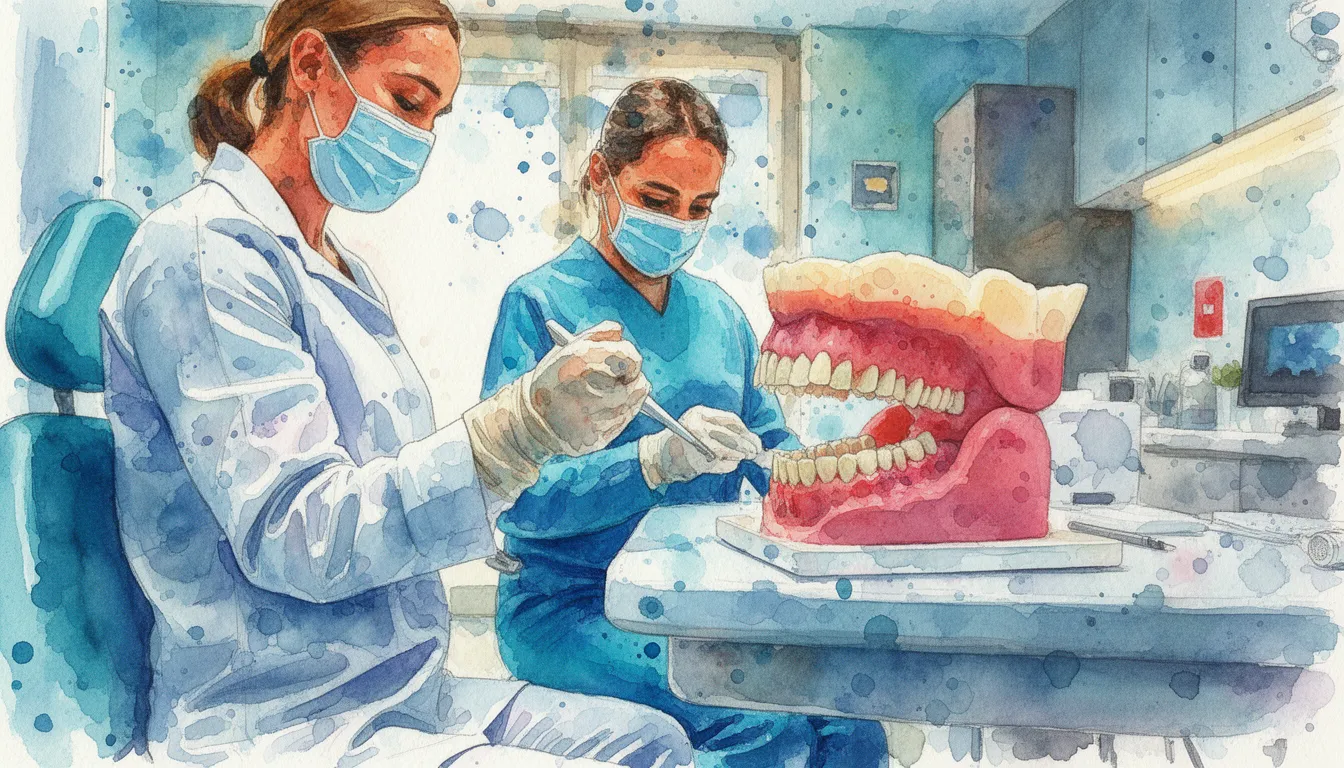
What Is Ridge Augmentation?
Ridge augmentation is a surgical procedure that rebuilds the bony ridge of your jaw where teeth once sat. A periodontist places bone graft material along the area of bone loss and covers it with a barrier membrane to guide new bone growth. Over several months, your body replaces the graft with natural bone tissue.
The alveolar ridge is the thick band of bone that surrounds and supports your teeth. When a tooth is extracted or lost to trauma, the bone that once held it in place begins to resorb, meaning the body breaks it down and absorbs it. This process can leave a narrow, flat, or uneven ridge. A systematic review published in the Journal of Clinical Periodontology found that the alveolar ridge can lose up to 50% of its width within the first 12 months after extraction, with most of this loss occurring in the first three months. [5] According to the American Academy of Periodontology, periodontal disease is also a leading cause of bone deterioration around teeth. [3]
Without enough bone, a dental implant cannot anchor securely. Ridge augmentation restores sufficient bone volume so that an implant can be placed in a stable position. The procedure may also improve the appearance of the gum line, which matters for front teeth where aesthetics are especially visible.
This procedure falls under the broader category of guided bone regeneration (GBR). In GBR, the membrane acts like a fence. It keeps fast-growing soft tissue from filling the space before slower-growing bone cells have time to mature. Researchers continue to study how different graft materials and membrane technologies can improve bone healing outcomes, including work on bioactive materials that may support faster and more predictable bone formation. [6]
When Is Ridge Augmentation Recommended?
Ridge augmentation is recommended when the jawbone is too thin or too short to support a dental implant safely. Your periodontist will evaluate the bone with a 3D scan and recommend grafting if the ridge does not meet the minimum dimensions for implant stability.
- Bone loss after extraction: The alveolar ridge can lose a significant percentage of its width within the first year after a tooth is removed. A systematic review by Tan and colleagues found that horizontal bone loss averaged 3.8 mm in the first six months post-extraction. [5] Without socket preservation at the time of extraction, this loss accelerates.
- Long-term tooth loss: The longer a tooth has been missing, the more bone resorption occurs. Patients who have been missing teeth for several years often need augmentation before implant placement.
- Periodontal disease: Advanced gum disease, known as periodontitis, destroys the bone that supports teeth. Even after the disease is treated, the lost bone does not grow back on its own. [3]
- Trauma or injury: A blow to the face can fracture or crush the alveolar ridge, leaving insufficient bone for future restoration.
- Poorly fitting dentures: Dentures that press on the ridge over many years can accelerate bone loss. Ridge augmentation can rebuild the foundation for implant-supported dentures.
- Cosmetic ridge defects: Even when an implant is not planned, ridge augmentation may be performed to fill in a visible depression in the gum line that affects appearance.
Ridge Augmentation vs. Sinus Lift
Patients sometimes confuse ridge augmentation with a sinus lift. These are related but distinct procedures. A sinus lift adds bone to the upper back jaw, specifically beneath the maxillary sinus cavity, which tends to expand downward after upper molars are removed. Ridge augmentation can be performed on any area of the upper or lower jaw where the ridge itself has lost width or height.
In some cases, a patient may need both procedures. For example, an upper molar site might require a sinus lift for vertical bone height and ridge augmentation for horizontal width. Your periodontist will determine which combination is appropriate based on imaging results.
What to Expect: Before, During, and After the Procedure
Ridge augmentation involves a planning phase, a surgical appointment, and a multi-month healing period. Knowing what happens at each stage can help you prepare.
Before the Procedure
Your periodontist will begin with a thorough examination. This typically includes a cone beam computed tomography (CBCT) scan, which is a 3D X-ray that shows the exact dimensions of your jawbone. The scan reveals where bone is deficient and how much graft material is needed.
You will discuss your medical history, current medications, and any conditions that affect healing. Smoking, uncontrolled diabetes, and certain medications like bisphosphonates can affect bone regeneration. Your periodontist may ask you to stop smoking or adjust medications before surgery.
The type of graft material will also be decided during this phase. There are four main categories. Autograft uses bone harvested from another site in your body, often the chin or the back of the lower jaw. Allograft uses processed human donor bone from a tissue bank. Xenograft uses animal-derived bone, most commonly bovine (cow) bone. Alloplast uses synthetic materials such as hydroxyapatite or calcium phosphate. A Cochrane systematic review found limited evidence to declare one graft material clearly superior to others for ridge augmentation, though autograft remains a widely used option because it contains living bone cells. [6] Your periodontist will recommend the best option for your specific defect based on the size and location of the bone loss.
During the Procedure
Ridge augmentation is typically performed under local anesthesia, meaning the area is numbed but you remain awake. Sedation options such as oral sedation or intravenous (IV) sedation may be available for patients who experience anxiety.
The periodontist makes an incision in the gum tissue to expose the deficient bone ridge. The bone surface is cleaned and small perforations may be made in the existing bone. These tiny holes encourage blood flow and help the graft integrate with natural bone.
Graft material is then placed along the ridge to build up the missing dimension. A resorbable or non-resorbable membrane is placed over the graft. This barrier membrane prevents the faster-growing gum tissue from invading the space before bone cells can fill it in. In some cases, the periodontist may use a rotated tissue flap from the palate or advanced soft tissue management techniques to achieve complete wound closure over the graft site, which is critical for successful healing.
The gum tissue is repositioned and sutured closed. The entire procedure typically takes 45 minutes to 2 hours, depending on the size of the defect and the grafting technique used.
After the Procedure
You will leave the office with gauze over the surgical site. Some bleeding, swelling, and discomfort are normal during the first few days. Your periodontist will prescribe or recommend pain medication, an antibiotic to prevent infection, and an antimicrobial mouth rinse.
You should avoid chewing on the surgical side, eating hard or crunchy foods, and using a straw for at least the first week. A soft food diet is recommended during early healing. Avoid brushing directly over the surgical site until your periodontist gives clearance, typically at your first follow-up visit.
Risks and Possible Complications
Ridge augmentation is a well-established procedure, but like any surgery, it carries risks. Understanding these risks ahead of time helps you make an informed decision and recognize early signs of a problem.
- Membrane exposure: The most commonly reported complication in guided bone regeneration is early exposure of the barrier membrane through the gum tissue. A systematic review by Aghaloo and Moy found that membrane exposure can reduce the amount of bone gained at the graft site. [7] Your periodontist will design the soft tissue closure to minimize this risk.
- Infection: Bacterial infection at the graft site can compromise healing. Antibiotics and careful post-operative hygiene help reduce this risk.
- Graft resorption: In some cases, the body may resorb more of the graft material than expected, resulting in less bone volume than planned. A second grafting procedure may be needed.
- Nerve injury: Procedures on the lower jaw carry a small risk of temporary or, in rare cases, lasting numbness in the lip or chin if the inferior alveolar nerve is affected.
- Smoking and systemic health: Smoking significantly increases the risk of graft complications. Uncontrolled diabetes and certain immune conditions can also slow healing. Your periodontist will discuss how your health history affects your individual risk.
Recovery Timeline and Aftercare
Recovery from ridge augmentation follows a gradual timeline, with most patients returning to normal activities within one to two weeks. Full bone maturation, however, takes several months.
Healing Milestones
Day 1 to 3: Swelling peaks around 48 to 72 hours after surgery. Ice packs applied to the outside of the face in 20-minute intervals can help reduce swelling. Moderate pain is normal and typically managed with prescribed medication. Rest with your head elevated.
Week 1: Swelling begins to subside. You will return for a follow-up appointment so your periodontist can check the surgical site and possibly remove sutures. Bruising may appear along the jaw or neck. Stick to soft foods such as yogurt, scrambled eggs, and mashed potatoes.
Week 2 to 4: Most patients feel comfortable returning to all normal daily activities. Mild tenderness at the site may persist. You can typically begin gentle brushing near the area as directed.
Month 2 to 4: The graft is integrating with the surrounding bone. New blood vessels and bone cells are colonizing the graft material. Avoid heavy impact to the area.
Month 4 to 9: Your periodontist will take follow-up imaging to assess bone density and volume. Once the bone has matured sufficiently, the site is ready for implant placement. The exact timeline depends on the size of the original defect, the graft material used, and individual healing factors.
Normal Symptoms vs. When to Call the Office
Some symptoms after surgery are expected and will resolve on their own. Others may signal a complication that needs prompt attention.
- Normal: Mild to moderate swelling for the first 3 to 5 days. Minor oozing of blood during the first 24 hours. Bruising around the jaw. A dull ache at the surgical site.
- Call your periodontist: Heavy bleeding that does not stop with firm gauze pressure after 30 minutes. Severe or worsening pain after the third day. Fever above 101°F (38.3°C). Pus or a foul taste coming from the surgical site. A feeling that the graft material is loose or exposed through the gum tissue.
Cost of Ridge Augmentation
Ridge augmentation typically costs between $500 and $3,000 per site. Costs vary by location, provider, and case complexity. Several factors influence where your case falls within that range.
- Extent of bone loss: A small localized defect requires less graft material and shorter surgical time than a large defect spanning multiple tooth sites.
- Graft material type: Autograft may involve a second surgical site for bone harvesting, which adds to the cost. Allograft and xenograft materials have processing and sourcing costs. Synthetic alloplast materials vary widely in price.
- Membrane type: Resorbable membranes dissolve on their own. Non-resorbable membranes require a second minor procedure for removal, adding to the total cost.
- Sedation: If IV sedation is used instead of local anesthesia alone, the anesthesia fee is an additional charge.
- Geographic location: Fees for the same procedure can differ substantially between urban and rural areas or between different regions of the country.
Insurance and Financing
Dental insurance coverage for ridge augmentation varies. Some plans classify it as a major surgical procedure and cover a percentage, often 50%, after the deductible. Other plans consider bone grafting a pre-implant procedure and may not cover it at all. Medical insurance may cover ridge augmentation if it is needed due to trauma or a medical condition rather than purely for dental implant preparation.
Ask your periodontist's office for a pre-treatment estimate. They can submit the procedure codes to your insurance carrier to get a benefits determination before surgery. Many practices also offer payment plans or work with third-party financing companies to spread the cost over monthly payments. The American Dental Association recommends discussing all costs and payment options with your dental office before treatment begins. [4]
Why See a Periodontist for Ridge Augmentation?
A periodontist is a dentist with advanced training in the bone and soft tissue structures that support your teeth. Periodontists complete an additional three years of specialty education after dental school, focusing on procedures like bone grafting, guided bone regeneration, and implant placement. [3]
While some general dentists perform bone grafting, ridge augmentation for moderate to severe bone loss often involves complex techniques. These may include harvesting bone from a donor site, shaping the graft to match the contour of the ridge, and using advanced membrane and flap techniques to achieve primary wound closure. A periodontist performs these procedures regularly and is trained to manage complications if they arise.
If your general dentist identifies bone loss on your imaging, they may refer you to a periodontist for evaluation. You can also seek a consultation directly. Visit the periodontics page to learn more about what periodontists treat and how to find one in your area.
For cases involving significant medical history factors, such as a history of bisphosphonate use, diabetes, or radiation therapy to the jaw, a periodontist's specialized training is especially valuable. These conditions can affect bone healing, and a specialist can adjust the surgical plan accordingly.
Find a Periodontist Near You
If you have been told you need bone grafting before an implant, or if you are missing teeth and want to explore your options, a periodontist can evaluate your bone with a 3D scan and create a treatment plan specific to your anatomy. Use the My Specialty Dentist directory to search for a board-certified periodontist by zip code. Visit the periodontics page to start your search and learn more about what to expect at a periodontal consultation.
Search Periodontists in Your Area